



.svg)
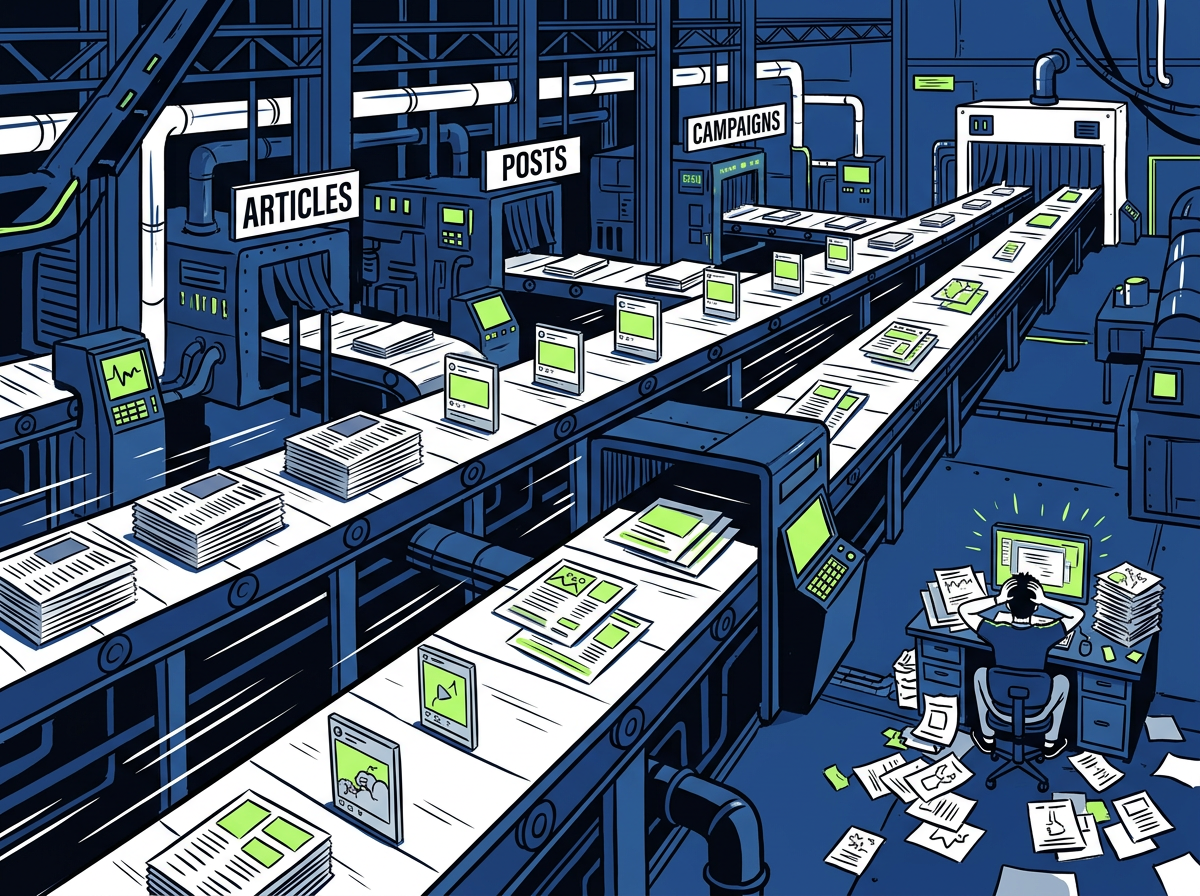
Scaling content marketing is rarely limited by strategy. It is limited by execution. Most businesses and agencies know what they should be doing. Publish consistently. Target the right keywords. Stay visible across search and social. The challenge is maintaining that level of output over time without overwhelming internal resources.
What starts as a manageable workflow often turns into a bottleneck. Content slows down, publishing becomes inconsistent, and growth plateaus.
- Online growth stalls when manual content workflows cannot sustain consistent publishing over time.
- Automation enables scalable marketing by turning repetitive tasks into continuous, system-driven processes.
- Relying on manual execution limits output, creates bottlenecks, and ties growth to available resources.
- Well-defined automation workflows ensure consistent content across blogs, local listings, and social channels.
- Centralized brand context keeps automated content aligned, allowing scale without sacrificing consistency or control.
Understanding the role of automation in marketing scalability
Consistency is one of the most important factors in long-term marketing performance.
Regular publishing helps:
- Build search visibility over time
- Reinforce topical authority
- Maintain audience engagement
- Create compounding traffic growth
However, maintaining consistency manually requires significant time and effort. As workload increases, execution becomes harder to sustain.
Automation addresses this by shifting the focus from individual tasks to repeatable systems.
.png)
Why manual workflows limit long-term growth
Many teams rely on manual processes for content creation and distribution. While this provides control, it also introduces limitations.
Common challenges include:
- Time constraints that delay content production
- Inconsistent publishing schedules
- Difficulty managing multiple platforms or clients
- Increased reliance on additional hires to scale output
Over time, these constraints make it difficult to maintain momentum. Growth becomes tied to available bandwidth rather than opportunity.
Moving from task-based execution to system-driven growth
A more scalable approach is to define your marketing workflows once and allow them to run continuously.
Instead of creating content one piece at a time, you establish rules for how content should be generated, published, and distributed.
Within Helm, this is handled through automation workflows that turn content marketing into an ongoing system rather than a series of manual tasks.
Once configured, these workflows continue operating in the background, supporting consistent execution without requiring daily input.
Defining automated workflows for different content types
Automation becomes most effective when it is tailored to specific types of content.
Within the platform, workflows can be configured to support multiple channels and objectives.
Automating blog content for consistent SEO growth
Blog content remains a core driver of organic traffic.
By defining a core keyword and content direction, the system can continuously generate articles that align with your strategy. These articles are structured to support SEO performance, including internal linking and supporting visuals where needed .
This ensures that content production remains active without requiring manual creation for each post.
Automating Google Business Profile updates for local visibility
For businesses focused on local search, maintaining an active Google Business Profile is essential.
Automation allows you to publish regular updates without needing to create each post individually. Content can also be aligned with blog publishing, ensuring that every new article contributes to local visibility through synchronized updates .
This creates a more cohesive local SEO strategy.
Automating social media content for ongoing engagement
Social media consistency is often difficult to maintain alongside other marketing efforts.
Automated workflows allow you to define posting styles, select platforms, and schedule recurring content. This ensures that your brand remains active without requiring constant manual input .
Ensuring quality through centralized brand context
Automation is only effective if the output remains aligned with your brand.
Without proper context, automated content can feel inconsistent or generic. This is why a centralized brand system is critical.
Within Helm, all automation workflows pull from a shared Brand Portal that defines:
- Brand voice and tone
- Key messaging and differentiators
- Target audience and personas
- Visual identity and assets
Because every piece of automated content references this foundation, consistency is maintained even as output scales .
Maintaining control while scaling output
Automation does not remove control. It restructures it.
Instead of controlling each individual task, you control the system that produces those tasks.
Key areas of control include:
- Content frequency and publishing schedule
- Specific days and timeframes for output
- Visual preferences and asset selection
- Overall content direction and focus
All generated content is also visible within a centralized calendar, allowing you to review, adjust, or refine outputs as needed .
This balance ensures that automation supports your strategy without removing oversight.
Common mistakes that limit automation effectiveness
Even with automation in place, certain mistakes can reduce impact:
1. Treating automation as a set-and-forget tool
Regular review is still needed to refine strategy.
2. Skipping foundational setup
Without proper brand context, outputs may lack consistency.
3. Overlooking scheduling and pacing
Poorly configured frequency can lead to uneven publishing.
4. Not aligning workflows across channels
Disconnected automations reduce overall effectiveness.
Avoiding these issues ensures that automation works as intended.
Building a system that supports continuous growth
Sustainable growth comes from consistency over time.
By shifting from manual execution to structured automation, businesses and agencies can:
- Maintain steady content output
- Reduce operational workload
- Scale across multiple channels
- Focus more on strategy than execution
Within Helm, automation is designed to support this shift by turning content marketing into a continuous system.
When workflows are properly configured, your marketing efforts no longer depend on daily input. Instead, they operate in the background, driving visibility and growth while you focus on higher-level priorities.
Get free resources, access to new features, tips & tricks, and special offers by joining the Helm Newsletter.
No Spam. Sent Weekly.