


.svg)
Content marketing is no longer just about written content. Visuals play a critical role in how content is consumed, shared, and remembered. Strong visuals help capture attention, improve engagement, and reinforce brand identity. However, producing them consistently is where most teams struggle.
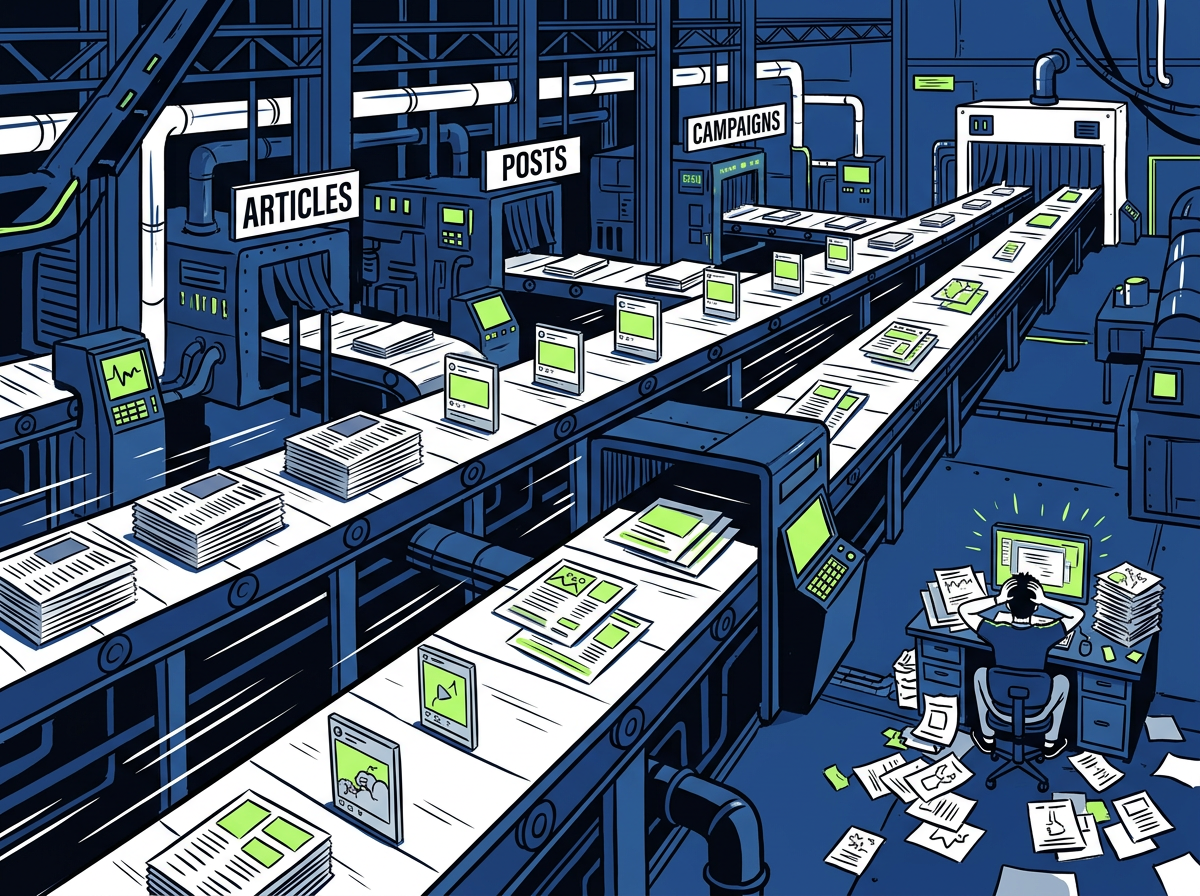
What starts as a few well-designed assets often turns into a bottleneck. Design requests pile up, turnaround times slow down, and content production becomes dependent on limited resources. As output increases, maintaining quality and consistency becomes harder to sustain.
- Visual content becomes a bottleneck at scale when design workflows cannot keep up with content production demands.
- Strong visuals are essential for engagement, brand consistency, and overall content performance.
- Traditional design processes are slow, costly, and difficult to maintain consistently across growing output.
- Integrating visual creation directly into content workflows enables faster, more scalable production.
- Centralized brand alignment ensures visuals remain consistent and on-brand as content scales.
Understanding the role of visuals in content performance
Visual content is not just a complement to written material. It directly impacts how content performs.
Effective visuals help:
- Improve readability and engagement
- Reinforce brand identity across channels
- Increase shareability on social platforms
- Support conversions through stronger presentation
When visuals are consistent and aligned with your messaging, they strengthen the overall impact of your content. When they are inconsistent or generic, they can weaken it.
Why traditional design workflows do not scale
Many businesses rely on designers or external tools to create visuals. While this ensures quality, it introduces limitations as content volume grows.
Common challenges include:
- Delays caused by design queues
- High costs for ongoing asset creation
- Inconsistent styles across different designers or tools
- Friction between content creation and visual production
These constraints make it difficult to maintain both speed and consistency at scale.
Moving from design dependency to integrated creation
A more scalable approach is to bring visual creation directly into your content workflow.
Instead of relying on separate tools or teams, visuals are generated and managed within the same system used for content and strategy.
Within Helm, this is handled through Media Studio, a built-in environment for creating, transforming, and managing visual assets alongside your content.
This integration reduces friction and allows visuals to scale with your content output.
Generating visuals directly from concepts
One of the most effective ways to streamline visual creation is to remove the need for complex design processes.
Within Media Studio, visuals can be generated from simple descriptions. Instead of relying on advanced design tools, users can define what they want and allow the system to create it.
This includes:
- Using prompt suggestions to refine ideas
- Selecting aspect ratios based on content type
- Generating images tailored to specific use cases
This approach makes visual creation more accessible while maintaining relevance to the content being produced .
Transforming existing assets into usable content
Not all visuals need to be created from scratch.
Existing images can be enhanced and repurposed to fit different contexts. This is especially valuable for product-based businesses or brands with existing asset libraries.
Media Studio allows users to:
- Upload existing images
- Modify backgrounds or environments
- Adapt visuals for different campaigns or formats
This reduces the need for repeated photo shoots while still enabling high-quality output .
.png)
Creating promotional visuals without external tools
Marketing often requires quick turnaround for promotional content.
Instead of relying on separate design workflows, integrated tools allow users to generate ad creatives directly within the platform.
This includes:
- Applying brand styles to maintain consistency
- Generating layouts based on simple inputs
- Creating multiple variations quickly for testing
By simplifying this process, teams can produce promotional visuals more efficiently while maintaining alignment with their overall content strategy .
Maintaining control through editing and refinement
While automation increases speed, control remains important.
Media Studio includes both AI-driven and manual editing capabilities, allowing users to refine visuals as needed. This includes:
- Cropping, resizing, and adjusting layouts
- Modifying colors and applying filters
- Adding text or annotations
This balance ensures that visuals can be generated quickly while still meeting specific requirements .
Ensuring consistency through centralized brand alignment
Visual consistency depends on having a clearly defined brand system.
By aligning Media Studio with a centralized Brand Portal, every generated image can reflect:
- Brand colors and visual style
- Messaging and positioning
- Overall aesthetic consistency
This ensures that visuals remain aligned with your brand, even as content output increases .
Organizing and reusing visual assets efficiently
As content production scales, managing assets becomes just as important as creating them.
A centralized library allows users to:
- Store generated visuals in one location
- Organize assets for quick retrieval
- Reuse images across different pieces of content
This reduces duplication and improves efficiency across workflows .
Common mistakes that limit visual content effectiveness
Even with the right tools, certain mistakes can reduce impact:
1. Relying too heavily on generic visuals
This weakens brand identity and reduces differentiation.
2. Separating visual creation from content strategy
This leads to misalignment between visuals and messaging.
3. Not defining brand styles upfront
Inconsistent visuals become more likely as output increases.
4. Overcomplicating the design process
This slows down production and limits scalability.
Avoiding these issues allows visuals to support, rather than slow down, your content efforts.
Building a visual system that scales with your content
Visual content should not be a bottleneck. It should be an integrated part of your marketing system.
By combining creation, editing, and management within a single environment, businesses and agencies can:
- Produce visuals at the same pace as content
- Maintain consistency across all assets
- Reduce reliance on external tools or teams
- Scale output without increasing complexity
Within Helm, Media Studio is designed to support this shift by making visual content creation part of the overall content workflow.
When visuals are fully integrated, content production becomes more efficient, more consistent, and easier to scale over time.
Get free resources, access to new features, tips & tricks, and special offers by joining the Helm Newsletter.
No Spam. Sent Weekly.